Two British traffic patrol officers from North Berwick, east of Edinburgh, were involved in an unusual incident, while checking for speeding motorists on the A1 Great North Road.
One of the officers (who are not named) used a hand-held radar device to check the speed of a vehicle approaching over the crest of a hill, and was suprised when the speed was recorded at over 300 mph. The machine then stopped working and the officers were not able to reset it.
The radar had in fact locked on to a NATO Tornado fighter jet over the North Sea, which was engaged in a low-flying exercise over the Borders district.
Back at police headquarters the chief constable fired off a stiff complaint to the RAF Liaison office.
Back came the reply in true laconic RAF style. "Thank you for your message, which allows us to complete the file on this incident. You may be interested to know that the tactical computer in the Tornado had automatically locked on to your 'hostile radar equipment' and sent a jamming signal back to it. Furthermore, the Sidewinder air-to-ground missiles aboard the fully-armed aircraft had also locked on to the target. Fortunately the Dutch pilot flying the Tornado responded to the missile status alert intelligently and was able to override the automatic protection system before the missile was launched."
2008-04-29


2008-04-14
Exercising your imagination keeps you human.
They say a picture is worth a thousand words; I would rather use one hundred words, and create an infinite number of pictures in the minds of my readers.
The primary purpose of humanity is to create, be it buildings, babies, books or what-have-you. Everything begins as an idea inside someone's head, and through creative and physical endeavour, becomes reality. Imagination is the engine of creative thought, and the more mental detail one can give to a creation that exists only in the mind's eye, the more powerful the creation and the greater impact the creation has once it reaches reality.
Like any skill, imagination works only when it is kept well exercised. However, the more we are exposed to visual representations of an alternate reality, and the more "real" that alternate reality is portrayed, the less our imagination is asked to 'fill in the gaps' to achieve a believable immersion in that reality. The easier it becomes to 'believe' what we are seeing on the screen -- be it TV, movies, or computer games -- the more our imagination becomes stunted and inflexible. We lose the ability to craft that important fine detail on the images within our minds.
Boredom is the hallmark of a dead or dying imagination ... and without imagination, we lose the ability to create. Once we cannot create, we cease to be human. I firmly believe that we have to create regularly -- prose, visual arts, dancing, programming, whatever -- or we go mad.
I read at least one novel per week. I estimate I watch a grand total of six hours of TV/movies per year. I rarely play computer games, and the less eye candy they have, the more I like them -- interactive text adventures like the original Infocom titles are, for me, the high art of gaming.
And you know what? I'm never bored. If I'm not reading, I'll be off visiting like-minded people, or building something, or making music, or writing something of my own purely for the sake of writing. I like being domestic, I like being a social butterfly, I like solitude and the stillness that comes with meditation.
Television tells us what to think and how to think. People who watch television (or any other form of visual entertainment with a high degree of realism) regularly, lose the ability to think -- I mean *really* think -- for themselves, and end up spending too much of their time living inside other people's heads instead of their own.
Be who you are and say what you feel, those that mind don't matter and those that matter don't mind :)
The primary purpose of humanity is to create, be it buildings, babies, books or what-have-you. Everything begins as an idea inside someone's head, and through creative and physical endeavour, becomes reality. Imagination is the engine of creative thought, and the more mental detail one can give to a creation that exists only in the mind's eye, the more powerful the creation and the greater impact the creation has once it reaches reality.
Like any skill, imagination works only when it is kept well exercised. However, the more we are exposed to visual representations of an alternate reality, and the more "real" that alternate reality is portrayed, the less our imagination is asked to 'fill in the gaps' to achieve a believable immersion in that reality. The easier it becomes to 'believe' what we are seeing on the screen -- be it TV, movies, or computer games -- the more our imagination becomes stunted and inflexible. We lose the ability to craft that important fine detail on the images within our minds.
Boredom is the hallmark of a dead or dying imagination ... and without imagination, we lose the ability to create. Once we cannot create, we cease to be human. I firmly believe that we have to create regularly -- prose, visual arts, dancing, programming, whatever -- or we go mad.
I read at least one novel per week. I estimate I watch a grand total of six hours of TV/movies per year. I rarely play computer games, and the less eye candy they have, the more I like them -- interactive text adventures like the original Infocom titles are, for me, the high art of gaming.
And you know what? I'm never bored. If I'm not reading, I'll be off visiting like-minded people, or building something, or making music, or writing something of my own purely for the sake of writing. I like being domestic, I like being a social butterfly, I like solitude and the stillness that comes with meditation.
Television tells us what to think and how to think. People who watch television (or any other form of visual entertainment with a high degree of realism) regularly, lose the ability to think -- I mean *really* think -- for themselves, and end up spending too much of their time living inside other people's heads instead of their own.
Be who you are and say what you feel, those that mind don't matter and those that matter don't mind :)
2008-01-16
Guys' Rules
Misappropriated from some random backwater of the intertubes ...
The Guys' Rules
Please note... these are all numbered "1" ON PURPOSE!
1. Men ARE NOT mind readers.
1. Learn to work the toilet seat. You're a big girl. If it's up, put it down. We need it up, you need it down. You don't hear us complaining about you leaving it down.
1. Sunday sports. It's like the full moon or the changing of the tides. Let it be.
1. Shopping is NOT a sport. And no, we are never going to think of it that way.
1. Crying is blackmail.
1. Ask for what you want. Let us be clear on this one: Subtle hints do not work! Strong hints do not work! Obvious hints do not work! Just say it!
1. 'Yes' and 'No' are perfectly acceptable answers to almost every question.
1. Come to us with a problem only If you want help solving it. That's what we do. Sympathy is what your girlfriends are for.
1. A headache that lasts for 17 months is a problem. See a doctor.
1. Anything we said 6 months ago is inadmissible in an argument. In fact, all comments become null and void after 7 Days.
1. If you won't dress like the Victoria's Secret girls, don't expect us to act like soap opera guys.
1. If you think you're fat, you probably are. Don't ask us.
1. If something we said can be interpreted two ways and one of the ways makes you sad or angry, we meant the other one.
1. You can either ask us to do something or tell us how you want it done. Not both. If you already know best how to do it, just do it yourself.
1. Whenever possible, please say whatever you have to say during commercials.
1. Christopher Columbus did NOT need directions and neither do we.
1. ALL men see in only 16 colors, like Windows default settings. Peach, for example, is a fruit, not a colour. Pumpkin is also a fruit. We have no idea what a mauve is.
1. If it itches, it will be scratched. We do that.
1. If we ask what is wrong and you say "nothing," we will act like nothing's wrong. We know you are lying, but it is just not worth the hassle.
1. If you ask a question you don't want an answer to, expect an answer you don't want to hear.
1. When we have to go somewhere, absolutely anything you wear Is fine. Really.
1. Don't ask us what we're thinking about unless you are prepared to discuss such topics as sport, the shotgun formation, or golf.
1. You have enough clothes.
1. You have too many shoes.
1. I am in shape. Round IS a shape!
1. Thank you for reading this. Yes, I know, I have to sleep on the couch tonight; but did you know men really don't mind that? It's like camping.
The Guys' Rules
Please note... these are all numbered "1" ON PURPOSE!
1. Men ARE NOT mind readers.
1. Learn to work the toilet seat. You're a big girl. If it's up, put it down. We need it up, you need it down. You don't hear us complaining about you leaving it down.
1. Sunday sports. It's like the full moon or the changing of the tides. Let it be.
1. Shopping is NOT a sport. And no, we are never going to think of it that way.
1. Crying is blackmail.
1. Ask for what you want. Let us be clear on this one: Subtle hints do not work! Strong hints do not work! Obvious hints do not work! Just say it!
1. 'Yes' and 'No' are perfectly acceptable answers to almost every question.
1. Come to us with a problem only If you want help solving it. That's what we do. Sympathy is what your girlfriends are for.
1. A headache that lasts for 17 months is a problem. See a doctor.
1. Anything we said 6 months ago is inadmissible in an argument. In fact, all comments become null and void after 7 Days.
1. If you won't dress like the Victoria's Secret girls, don't expect us to act like soap opera guys.
1. If you think you're fat, you probably are. Don't ask us.
1. If something we said can be interpreted two ways and one of the ways makes you sad or angry, we meant the other one.
1. You can either ask us to do something or tell us how you want it done. Not both. If you already know best how to do it, just do it yourself.
1. Whenever possible, please say whatever you have to say during commercials.
1. Christopher Columbus did NOT need directions and neither do we.
1. ALL men see in only 16 colors, like Windows default settings. Peach, for example, is a fruit, not a colour. Pumpkin is also a fruit. We have no idea what a mauve is.
1. If it itches, it will be scratched. We do that.
1. If we ask what is wrong and you say "nothing," we will act like nothing's wrong. We know you are lying, but it is just not worth the hassle.
1. If you ask a question you don't want an answer to, expect an answer you don't want to hear.
1. When we have to go somewhere, absolutely anything you wear Is fine. Really.
1. Don't ask us what we're thinking about unless you are prepared to discuss such topics as sport, the shotgun formation, or golf.
1. You have enough clothes.
1. You have too many shoes.
1. I am in shape. Round IS a shape!
1. Thank you for reading this. Yes, I know, I have to sleep on the couch tonight; but did you know men really don't mind that? It's like camping.
2007-11-17
The Zen of Attraction
Ten Principles To The Zen Of Attraction
1. Promise Nothing. Just do what you most enjoy doing. Hidden benefit: You will always over-deliver.
2. Offer Nothing. Just share what you have with those who express an interest in it. Hidden benefit: Takes the pressure off of wanting other people to see you as valuable or important.
3. Expect Nothing. Just enjoy what you already have. It’s plenty. Hidden benefit: You will realize how complete your life is already.
4. Need Nothing. Just build up your reserves and your needs will disappear. Hidden benefit: You boundaries will be extended and filled with space.
5. Create Nothing. Just respond well to what comes to you. Hidden benefit: Openness.
6. Hype Nothing. Just let quality sell by itself. Hidden benefit: Trustability.
7. Plan Nothing. Just take the path of least resistance. Hidden benefit: Achievement will become effortless.
8. Learn Nothing. Just let your body absorb it all on your behalf. Hidden benefit: You will become more receptive to what you need to know in the moment.
9. Become No One. Just be more of yourself. Hidden benefit: Authenticity.
10. Change Nothing. Just tell the truth and things will change by themselves. Hidden benefit: Acceptance.
Be yourself to see yourself to free yourself to be your Self.
"I think many people reading this will not understand the meaning of “nothing” as it relates to Zen ... unless, of course, you’ve studied some Buddhism. Shunyata, or emptiness, is the central Buddhist notion that all things are empty, impermanent, devoid of an essence, and characterized by suffering. This doesn’t mean to take the view of nihilism, rather, to see beyond the illusion through the practice of awakening. Take the red pill. :)
"It’s really tough to get the concept of Shunyata intellectually because it requires some diligent practice and probably some direct Satori experience.
"If for nothing else, let this post be a way to stretch the mind or to temporarily practice something that may seem counterintuitive."
(thanks to Graham English)
1. Promise Nothing. Just do what you most enjoy doing. Hidden benefit: You will always over-deliver.
2. Offer Nothing. Just share what you have with those who express an interest in it. Hidden benefit: Takes the pressure off of wanting other people to see you as valuable or important.
3. Expect Nothing. Just enjoy what you already have. It’s plenty. Hidden benefit: You will realize how complete your life is already.
4. Need Nothing. Just build up your reserves and your needs will disappear. Hidden benefit: You boundaries will be extended and filled with space.
5. Create Nothing. Just respond well to what comes to you. Hidden benefit: Openness.
6. Hype Nothing. Just let quality sell by itself. Hidden benefit: Trustability.
7. Plan Nothing. Just take the path of least resistance. Hidden benefit: Achievement will become effortless.
8. Learn Nothing. Just let your body absorb it all on your behalf. Hidden benefit: You will become more receptive to what you need to know in the moment.
9. Become No One. Just be more of yourself. Hidden benefit: Authenticity.
10. Change Nothing. Just tell the truth and things will change by themselves. Hidden benefit: Acceptance.
Be yourself to see yourself to free yourself to be your Self.
"I think many people reading this will not understand the meaning of “nothing” as it relates to Zen ... unless, of course, you’ve studied some Buddhism. Shunyata, or emptiness, is the central Buddhist notion that all things are empty, impermanent, devoid of an essence, and characterized by suffering. This doesn’t mean to take the view of nihilism, rather, to see beyond the illusion through the practice of awakening. Take the red pill. :)
"It’s really tough to get the concept of Shunyata intellectually because it requires some diligent practice and probably some direct Satori experience.
"If for nothing else, let this post be a way to stretch the mind or to temporarily practice something that may seem counterintuitive."
(thanks to Graham English)
2007-08-13
IRC Personalities
Anyone who IRCs regularly know of a few distinct personalities that irritate to the core. It's almost as if there is a nest somewhere making sure that the supply of lost AOLers, obnoxious 13 year olds and elitist know nothings don't run out, no matter how many you try to kick/ban off the planet.
The Elitist Know Nothing: This guy talks about everything with complete authority and refuses to budge on any topic as if he were the one who invented it. In all actuality, The Elitist Know Nothing, picked up most everything he knows from biased trade journals written by other Elitist Know Nothings. He has never really ever applied any of his knowledge to see if it's actually true or not. He just assumes that it is, and makes sure that you know your 20 years of programming experience mean nothing in the face of his all knowing intellect.
The Lost AOLer: This guy somehow managed to find IRC. He doesn't know exactly where he is. He is constantly confused as to why the ##linux (must be some kind of kinky sex act) members don't want to cyber with him.
THE 10-15 YEAR OLD: THESE GUYS ARE A MIX BETWEEN THE LOST AOLER AND THE ELITIST KNOW NOTHING. THEY HAVE FIGURED OUT THAT THEIR COMPUTER IS PRETTY SPIFFY AND THAT QBASIC CAN MAKE IT DO SOME KEWL STUFF. THEY THINK CAPS LOOK KEWLER THAN LOWERCASE AND YOU CAN ONLY HOPE AND PRAY THAT SOMEONE DOESN'T TEACH THEM L337. THE BRIGHT SIDE IS THAT THE 10-15 YEAR OLD WILL MAGICALLY LOG ON ONE DAY A COMPLETELY DIFFERENT PERSON.
The Scary Asian/Arab: This kid barges in the channel and asks questions in mildly coherent English that most likely threaten every bit of security you have. For example: say you run a shell server, the Scary Asian will come asking for an account.. for stuff and ssh. When you ask what kind of stuff he will give some vague answer. You figure he's harmless because he kinda sounds like the 10-15 year old. Two weeks later all your bandwidth disappears and you find most of it going through a ssh tunnel he set up. The FBI knocks on your door to inquire about some files going through your server.
The I Can't Read The Topic Guy: This guy will wander into the channel and paste 30 lines of code right off. Of course the code is C and the channel is #perl, but that doesn't stop him. He then goes on to ask a question about the code while four other channel members try to explain various things to him such as "this is #perl" or "there's a pastebin for a reason." The I Can't read The Topic Guy will then make some sort of apology and go spam all 30 lines of code in #C.
The Enter Key Abuser: This Guy
Does not understand
that
pressing enter after every
1-5 words
is irritating
and that people would listen
to him more
if he stopped that
Mr. Offtopic: This guy never talks about anything on topic. He'll tell you about the state of his room, the color of his socks, or about how awesome the hot pockets him mom brought him are. Never mind the fact that this is the #cryptography channel and you are trying to explain something to someone. Mr. Offtopic does not actually need any interaction from other users. He will continue rambling on regardless.
The Evil Wizard: This is the guy that's been programming for 30 years and has achieved wizardry. His sole purpose in life is to hang out in the help channels and inform anyone who asks a question how dumb they are. He refuses to part with any useful knowledge and instead tells people to google it or links to the most cryptic documentation he knows of. Delights in making newbies give up on whatever they were trying to do.
The 50/50 Guy: This guy actually knows his stuff.. Half of the time. The other half he cycles between all the annoying IRC personalties. He'll be talking coherently about a C program he wrote one minute and then suddenly go into a string of expletives and tell you about his toenails.
The Observationalist: This guy thinks he is better than everybody on IRC because he is able to lump the vast majority of users into groups. He most likely posts his 'findings' on a popular blog website that has nothing to do with IRC. While he believes his research is good for a few laughs, the truth is he submits his blog to the Digg community, and hopes that a few of the users are at least aware of IRC so that he may derive a few chuckles.
The Expert In the Mist: This guy knows almost everything about the discussion topic. He can program in 30 different languages and can build just about any electronic device from scratch. He has the answer to ALL of your questions. The only problem is he only stops idling for about 10 minutes, 12:00 at night on the first full moon of the year if the ambient temperature in France is equal to the the average temperature of the arctic icecaps multiplied by negative pi.
Mr. Quits: This guy quits randomly, often in the middle of a conversation, with no warning at all. Mr. Quits will be 3 lines away from fully explaining how to fix that obscure problem with your system when he suddenly quits. Mr. Quits never means to leave you hanging but he does it with such frequency that one can only assume he has a subconscious need to frustrate and shatter hopes.
The Drunkard: This si thast guy who stll massags oi got oblime nd talk abt.... stuff... even after he's brought himself 2 drinks away from alcohol poisoning. He normally starts off by listing in detail exactly what beverages were consumed in order for him to bless you with his current state. Then he slowly becomes less and less coherent until he gives a semi-coherent away message and passes out.
The Unknown Idler: This guy has been idling since the channel was started. Upon checking the logs you find that he said "hi" about two years back. May be dead.
The Playlist: I've often wanted to know exactly what song the other channel members are listening to. Thankfully, The Playlist is there to help me out. Shamelessly informing everyone in approximately 3 minute intervals the poorly formatted title, artist and play time information of their blatantly pirated mp3s. To make matters worse, The Playlist normally has horrendously bad taste in music.
The Morally Terrifying: This guy has no discernible morals. The morally terrifying is the only one who thinks a discussion about gun-point rape and the like is a fun channel topic. Freud would have a heyday with this man. We can just hope his mother knows better than to hug him for too long at a time.
Lucifer the Op: Just try to wander off topic or be slightly abrasive and Lucifer will kick/ban for the next 3 months. Lucifer tends to select a few close friends who make sure that he doesn't miss an opportunity to ban someone.
The Uninformed: This guy will join in on the discussion and talk about the topic. Can get very repetitive and infuriating. Whether it be about religion or cars he will contribute something... normally obvious or blatantly wrong. Will make sure you completely understand that smaller tires give you better gas mileage.
The Internet Aggregator: This guy never says anything of his own (other than the occasional lol or yea) but constantly sends links of funny/interesting finds on the internet. A internet aggregator is most terrifying when paired with digg and bash.
The Bot: The Bot is a hideous twisted peice of code that sits in the channel and spams useless information. Normally some withered malicious soul controls the silly thing, making sure that it has all the features nobody wants, such as the google compare feature or the all popular insult generator. The Bot's owner will normally start using his bot during the most interesting discussion of the day, there by ending it. The Bot is often modeled after other annoying IRC personalities, so that the channel will always have an Internet Aggregator and Lucifer the Op.
(unashamedly stolen from Coatzee)
The Elitist Know Nothing: This guy talks about everything with complete authority and refuses to budge on any topic as if he were the one who invented it. In all actuality, The Elitist Know Nothing, picked up most everything he knows from biased trade journals written by other Elitist Know Nothings. He has never really ever applied any of his knowledge to see if it's actually true or not. He just assumes that it is, and makes sure that you know your 20 years of programming experience mean nothing in the face of his all knowing intellect.
The Lost AOLer: This guy somehow managed to find IRC. He doesn't know exactly where he is. He is constantly confused as to why the ##linux (must be some kind of kinky sex act) members don't want to cyber with him.
THE 10-15 YEAR OLD: THESE GUYS ARE A MIX BETWEEN THE LOST AOLER AND THE ELITIST KNOW NOTHING. THEY HAVE FIGURED OUT THAT THEIR COMPUTER IS PRETTY SPIFFY AND THAT QBASIC CAN MAKE IT DO SOME KEWL STUFF. THEY THINK CAPS LOOK KEWLER THAN LOWERCASE AND YOU CAN ONLY HOPE AND PRAY THAT SOMEONE DOESN'T TEACH THEM L337. THE BRIGHT SIDE IS THAT THE 10-15 YEAR OLD WILL MAGICALLY LOG ON ONE DAY A COMPLETELY DIFFERENT PERSON.
The Scary Asian/Arab: This kid barges in the channel and asks questions in mildly coherent English that most likely threaten every bit of security you have. For example: say you run a shell server, the Scary Asian will come asking for an account.. for stuff and ssh. When you ask what kind of stuff he will give some vague answer. You figure he's harmless because he kinda sounds like the 10-15 year old. Two weeks later all your bandwidth disappears and you find most of it going through a ssh tunnel he set up. The FBI knocks on your door to inquire about some files going through your server.
The I Can't Read The Topic Guy: This guy will wander into the channel and paste 30 lines of code right off. Of course the code is C and the channel is #perl, but that doesn't stop him. He then goes on to ask a question about the code while four other channel members try to explain various things to him such as "this is #perl" or "there's a pastebin for a reason." The I Can't read The Topic Guy will then make some sort of apology and go spam all 30 lines of code in #C.
The Enter Key Abuser: This Guy
Does not understand
that
pressing enter after every
1-5 words
is irritating
and that people would listen
to him more
if he stopped that
Mr. Offtopic: This guy never talks about anything on topic. He'll tell you about the state of his room, the color of his socks, or about how awesome the hot pockets him mom brought him are. Never mind the fact that this is the #cryptography channel and you are trying to explain something to someone. Mr. Offtopic does not actually need any interaction from other users. He will continue rambling on regardless.
The Evil Wizard: This is the guy that's been programming for 30 years and has achieved wizardry. His sole purpose in life is to hang out in the help channels and inform anyone who asks a question how dumb they are. He refuses to part with any useful knowledge and instead tells people to google it or links to the most cryptic documentation he knows of. Delights in making newbies give up on whatever they were trying to do.
The 50/50 Guy: This guy actually knows his stuff.. Half of the time. The other half he cycles between all the annoying IRC personalties. He'll be talking coherently about a C program he wrote one minute and then suddenly go into a string of expletives and tell you about his toenails.
The Observationalist: This guy thinks he is better than everybody on IRC because he is able to lump the vast majority of users into groups. He most likely posts his 'findings' on a popular blog website that has nothing to do with IRC. While he believes his research is good for a few laughs, the truth is he submits his blog to the Digg community, and hopes that a few of the users are at least aware of IRC so that he may derive a few chuckles.
The Expert In the Mist: This guy knows almost everything about the discussion topic. He can program in 30 different languages and can build just about any electronic device from scratch. He has the answer to ALL of your questions. The only problem is he only stops idling for about 10 minutes, 12:00 at night on the first full moon of the year if the ambient temperature in France is equal to the the average temperature of the arctic icecaps multiplied by negative pi.
Mr. Quits: This guy quits randomly, often in the middle of a conversation, with no warning at all. Mr. Quits will be 3 lines away from fully explaining how to fix that obscure problem with your system when he suddenly quits. Mr. Quits never means to leave you hanging but he does it with such frequency that one can only assume he has a subconscious need to frustrate and shatter hopes.
The Drunkard: This si thast guy who stll massags oi got oblime nd talk abt.... stuff... even after he's brought himself 2 drinks away from alcohol poisoning. He normally starts off by listing in detail exactly what beverages were consumed in order for him to bless you with his current state. Then he slowly becomes less and less coherent until he gives a semi-coherent away message and passes out.
The Unknown Idler: This guy has been idling since the channel was started. Upon checking the logs you find that he said "hi" about two years back. May be dead.
The Playlist: I've often wanted to know exactly what song the other channel members are listening to. Thankfully, The Playlist is there to help me out. Shamelessly informing everyone in approximately 3 minute intervals the poorly formatted title, artist and play time information of their blatantly pirated mp3s. To make matters worse, The Playlist normally has horrendously bad taste in music.
The Morally Terrifying: This guy has no discernible morals. The morally terrifying is the only one who thinks a discussion about gun-point rape and the like is a fun channel topic. Freud would have a heyday with this man. We can just hope his mother knows better than to hug him for too long at a time.
Lucifer the Op: Just try to wander off topic or be slightly abrasive and Lucifer will kick/ban for the next 3 months. Lucifer tends to select a few close friends who make sure that he doesn't miss an opportunity to ban someone.
The Uninformed: This guy will join in on the discussion and talk about the topic. Can get very repetitive and infuriating. Whether it be about religion or cars he will contribute something... normally obvious or blatantly wrong. Will make sure you completely understand that smaller tires give you better gas mileage.
The Internet Aggregator: This guy never says anything of his own (other than the occasional lol or yea) but constantly sends links of funny/interesting finds on the internet. A internet aggregator is most terrifying when paired with digg and bash.
The Bot: The Bot is a hideous twisted peice of code that sits in the channel and spams useless information. Normally some withered malicious soul controls the silly thing, making sure that it has all the features nobody wants, such as the google compare feature or the all popular insult generator. The Bot's owner will normally start using his bot during the most interesting discussion of the day, there by ending it. The Bot is often modeled after other annoying IRC personalities, so that the channel will always have an Internet Aggregator and Lucifer the Op.
(unashamedly stolen from Coatzee)
2007-08-12
Touch Me, Feel Me, Heal Me
[shamelessly lifted from an article in The Guardian, July 2007]
We have virtual friends, choose to live alone and are becoming less tactile with others. But touch is fundamental to our health, writes Laura Barton.
"Everybody needs touch, especially the elderly," says Beata Aleksandrowicz. "Very often they are alone, their partners have gone or have died or they're sick, and nobody is touching them." In a calmly lit treatment room in west London, Aleksandrowicz, a massage therapist, is speaking about a project she launched in June which saw therapists across the country give free hand massages to elderly people in nursing homes.
The response was heartening. "I had reactions such as, 'Oh, I had no idea that I need touch so much' or, 'Oh, it's like I'm in fairyland!'" But Aleksandrowicz found getting the project off the ground difficult - partly because of its name: Touch Me ... Please. The word "touch", she explains, has such negative connotations that some care homes were reluctant to become involved.
Bertrand Russell once wrote: "Not only our geometry and our physics, but our whole conception of what exists outside us is based upon the sense of touch." But our experience of touch is dwindling. Increasingly we live alone, have virtual friends, shy away from any kind of physical contact with strangers for fear it might be unhygienic, or inappropriate, or could become violent.
The effects of not touching can prove detrimental to our wellbeing, both as individuals and as a society. "When you touch or are touched, you get the feeling of being connected with yourself and with others," says Aleksandrowicz, placing one hand on my arm. "When I touch you, you feel my touch - so by my touch you feel that you exist, and you can connect with me. It is a feeling of being important, of being taken care of."
A 1997 study into the amount of touching and aggression among adolescents looked at the behaviour of 40 teenagers in McDonald's outlets in Paris and Miami. It found that American adolescents spent considerably less time stroking, kissing, hugging and leaning against their peers than their French counterparts did.
Interestingly, the Americans showed more self-touching - such as playing with rings on their fingers, wringing their hands, twirling hair, wrapping arms around themselves, cracking knuckles, biting their lips - and also behaviour that was more aggressive, verbally and physically, towards their peers.
These findings are worrying - particularly because research suggests that an absence of touching and physical interaction during adolescence may result in violent behaviour in later life. Touch deprivation appears to lead to a depletion in norepinephrine and serotonin, which, along with dopamine, are neurotransmitters affecting mood. When levels of norepinephrine and serotonin fall, levels of dopamine are left uninhibited - leading to the impulsive, often aggressive, behaviour associated with high levels of dopamine. (Research also suggests that levels of norepinephrine and serotonin may be increased through touch.)
And yet, even though we're isolating ourselves from it, humans crave physical touch. It is one of the reasons people keep pets, Aleksandrowicz believes: "Because they can touch them, they can exchange warmth with them." And we look for touch, too, Aleksandrowicz suspects, in casual sexual encounters. Not that we should. "Casual sex is not about touch, it's about sex, and sex is not necessarily touch," she says. "So you wake up in the morning with the feeling that it was a total mistake, and you still need to be held and embraced."
In many ways it was her own yearning for touch that brought Aleksandrowicz to massage. "I had some problems with my second husband," she says. "We had a lot of problems with intimacy, we couldn't open up for each other, and our friend just gave us the advice to try to touch each other a lot and just see how it goes. And I was amazed how closed I was to touch. I could not receive touch - it made me panic."
Now she offers courses for couples (as well as encouraging parents to massage their children, so they grow up to find touch usual). "You suddenly see these men who open up so much," she says.
Aleksandrowicz was born in Poland. She is wary of making generalisations about a nation, but in Britain, she says, "There is not a culture where touch is natural. We don't feel very confident in the presence of others, therefore touch is not natural, it's not organic, and the word 'touch' is so misused."
However, the situation is improving. Five years ago, when searching for premises for her company, Pure Massage, estate agents told Aleksandrowicz she would have to change the business's name. "We were looking for a property for two years!" Now massage has been solidly reclaimed as a reputable business.
But it is not just the UK where negative or uncomfortable attitudes have prevailed. Aleksandrowicz recently returned from a trip to meet bushmen in the Kalahari. She expected them to have a much freer approach to physical interaction - and was shocked to find that was not the case. "I was in the middle of Namibia, 40 degrees, sitting on the sand, with people who I've never seen before, whose culture is 40,000 years old, and they were all asking about touch," Aleksandrowicz says.
She massaged everyone in the village, sometimes several times over. The first to be massaged was the oldest woman in the village. "Suddenly there was silence, this whole village stopped what they were doing - they stopped talking and started to sing," says Aleksandrowicz. She believes that the political situation of the bushmen - landless, powerless, severed from their traditions and history - has led to this intense feeling of disconnection. "It was very interesting. All of them asked me to touch their chests - the most emotional part of the body, and also responsible for the ego. They don't know who they are - they're lost."
Some would say that people in the west are also losing sight of who they are. We shy from touching each other, but are obsessed with appearance. We would rather, for example, go under the surgeon's knife than accept our own bodies. "We are living in a materialistic time," says Aleksandrowicz, "where if you don't see, you don't have. So we have cars, we have high salaries, we have the right shape of our bottom ... But we stop believing that we have enormous potential inside us."
And what does Aleksandrowicz get from a career that involves touching people all day long? "It's amazing," she says sweetly. "It is a communication on the most basic fundamental level, where there are no words or judgment or ego. It's just the purest possible interaction between two people".
For more information on Aleksandrowicz's work, visit puremassage.com and touch-me-please.org
We have virtual friends, choose to live alone and are becoming less tactile with others. But touch is fundamental to our health, writes Laura Barton.
"Everybody needs touch, especially the elderly," says Beata Aleksandrowicz. "Very often they are alone, their partners have gone or have died or they're sick, and nobody is touching them." In a calmly lit treatment room in west London, Aleksandrowicz, a massage therapist, is speaking about a project she launched in June which saw therapists across the country give free hand massages to elderly people in nursing homes.
The response was heartening. "I had reactions such as, 'Oh, I had no idea that I need touch so much' or, 'Oh, it's like I'm in fairyland!'" But Aleksandrowicz found getting the project off the ground difficult - partly because of its name: Touch Me ... Please. The word "touch", she explains, has such negative connotations that some care homes were reluctant to become involved.
Bertrand Russell once wrote: "Not only our geometry and our physics, but our whole conception of what exists outside us is based upon the sense of touch." But our experience of touch is dwindling. Increasingly we live alone, have virtual friends, shy away from any kind of physical contact with strangers for fear it might be unhygienic, or inappropriate, or could become violent.
The effects of not touching can prove detrimental to our wellbeing, both as individuals and as a society. "When you touch or are touched, you get the feeling of being connected with yourself and with others," says Aleksandrowicz, placing one hand on my arm. "When I touch you, you feel my touch - so by my touch you feel that you exist, and you can connect with me. It is a feeling of being important, of being taken care of."
A 1997 study into the amount of touching and aggression among adolescents looked at the behaviour of 40 teenagers in McDonald's outlets in Paris and Miami. It found that American adolescents spent considerably less time stroking, kissing, hugging and leaning against their peers than their French counterparts did.
Interestingly, the Americans showed more self-touching - such as playing with rings on their fingers, wringing their hands, twirling hair, wrapping arms around themselves, cracking knuckles, biting their lips - and also behaviour that was more aggressive, verbally and physically, towards their peers.
These findings are worrying - particularly because research suggests that an absence of touching and physical interaction during adolescence may result in violent behaviour in later life. Touch deprivation appears to lead to a depletion in norepinephrine and serotonin, which, along with dopamine, are neurotransmitters affecting mood. When levels of norepinephrine and serotonin fall, levels of dopamine are left uninhibited - leading to the impulsive, often aggressive, behaviour associated with high levels of dopamine. (Research also suggests that levels of norepinephrine and serotonin may be increased through touch.)
And yet, even though we're isolating ourselves from it, humans crave physical touch. It is one of the reasons people keep pets, Aleksandrowicz believes: "Because they can touch them, they can exchange warmth with them." And we look for touch, too, Aleksandrowicz suspects, in casual sexual encounters. Not that we should. "Casual sex is not about touch, it's about sex, and sex is not necessarily touch," she says. "So you wake up in the morning with the feeling that it was a total mistake, and you still need to be held and embraced."
In many ways it was her own yearning for touch that brought Aleksandrowicz to massage. "I had some problems with my second husband," she says. "We had a lot of problems with intimacy, we couldn't open up for each other, and our friend just gave us the advice to try to touch each other a lot and just see how it goes. And I was amazed how closed I was to touch. I could not receive touch - it made me panic."
Now she offers courses for couples (as well as encouraging parents to massage their children, so they grow up to find touch usual). "You suddenly see these men who open up so much," she says.
Aleksandrowicz was born in Poland. She is wary of making generalisations about a nation, but in Britain, she says, "There is not a culture where touch is natural. We don't feel very confident in the presence of others, therefore touch is not natural, it's not organic, and the word 'touch' is so misused."
However, the situation is improving. Five years ago, when searching for premises for her company, Pure Massage, estate agents told Aleksandrowicz she would have to change the business's name. "We were looking for a property for two years!" Now massage has been solidly reclaimed as a reputable business.
But it is not just the UK where negative or uncomfortable attitudes have prevailed. Aleksandrowicz recently returned from a trip to meet bushmen in the Kalahari. She expected them to have a much freer approach to physical interaction - and was shocked to find that was not the case. "I was in the middle of Namibia, 40 degrees, sitting on the sand, with people who I've never seen before, whose culture is 40,000 years old, and they were all asking about touch," Aleksandrowicz says.
She massaged everyone in the village, sometimes several times over. The first to be massaged was the oldest woman in the village. "Suddenly there was silence, this whole village stopped what they were doing - they stopped talking and started to sing," says Aleksandrowicz. She believes that the political situation of the bushmen - landless, powerless, severed from their traditions and history - has led to this intense feeling of disconnection. "It was very interesting. All of them asked me to touch their chests - the most emotional part of the body, and also responsible for the ego. They don't know who they are - they're lost."
Some would say that people in the west are also losing sight of who they are. We shy from touching each other, but are obsessed with appearance. We would rather, for example, go under the surgeon's knife than accept our own bodies. "We are living in a materialistic time," says Aleksandrowicz, "where if you don't see, you don't have. So we have cars, we have high salaries, we have the right shape of our bottom ... But we stop believing that we have enormous potential inside us."
And what does Aleksandrowicz get from a career that involves touching people all day long? "It's amazing," she says sweetly. "It is a communication on the most basic fundamental level, where there are no words or judgment or ego. It's just the purest possible interaction between two people".
For more information on Aleksandrowicz's work, visit puremassage.com and touch-me-please.org
2007-07-01
Television: Creation of the Hive Mind
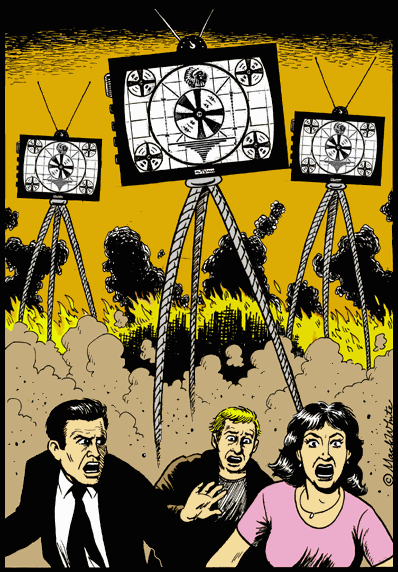
by Mack White
Jack Kerouac once noted, while walking down a residential street at night, glancing into living rooms lit by the gray glare of television sets, that we have become a world of people "thinking the same thoughts at the same time."
Every day, millions upon millions of human beings sit down at the same time to watch the same football game, the same mini-series, the same newscast. And where might all this shared experience and uniformity of thought be taking us?
Nearly seventy years ago, six million Americans became unwitting subjects in an experiment in psychological warfare.
It was the night before Halloween, 1938. At 8 p.m. CST, the Mercury Radio on the Air began broadcasting Orson Welles' radio adaptation of H. G. Wells' War of the Worlds. As is now well known, the story was presented as if it were breaking news, with bulletins so realistic that an estimated one million people believed the world was actually under attack by Martians. Of that number, thousands succumbed to outright panic, not waiting to hear Welles' explanation at the end of the program that it had all been a Halloween prank, but fleeing into the night to escape the alien invaders.
Later, psychologist Hadley Cantril conducted a study of the effects of the broadcast and published his findings in a book, The Invasion from Mars: A Study in the Psychology of Panic. This study explored the power of broadcast media, particularly as it relates to the suggestibility of human beings under the influence of fear. Cantril was affiliated with Princeton University's Radio Research Project, which was funded in 1937 by the Rockefeller Foundation. Also affiliated with the Project was Council on Foreign Relations (CFR) member and Columbia Broadcasting System (CBS) executive Frank Stanton, whose network had broadcast the program. Stanton would later go on to head the news division of CBS, and in time would become president of the network, as well as chairman of the board of the RAND Corporation, the influential think tank which has done groundbreaking research on, among other things, mass brainwashing.
Two years later, with Rockefeller Foundation money, Cantril established the Office of Public Opinion Research (OPOR), also at Princeton. Among the studies conducted by the OPOR was an analysis of the effectiveness of "psycho-political operations" (propaganda, in plain English) of the Office of Strategic Services (OSS), the forerunner of the Central Intelligence Agency (CIA). Then, during World War II, Cantril (and Rockefeller money) assisted CFR member and CBS reporter Edward R. Murrow in setting up the Princeton Listening Center, the purpose of which was to study Nazi radio propaganda with the object of applying Nazi techniques to OSS propaganda. Out of this project came a new government agency, the Foreign Broadcast Intelligence Service (FBIS). The FBIS eventually became the United States Information Agency (USIA), which is the propaganda arm of the National Security Council.
Thus, by the end of the 1940s, the basic research had been done and the propaganda apparatus of the national security state had been set up -- just in time for the Dawn of Television ...
Experiments conducted by researcher Herbert Krugman reveal that, when a person watches television, brain activity switches from the left to the right hemisphere. The left hemisphere is the seat of logical thought. Here, information is broken down into its component parts and critically analyzed. The right brain, however, treats incoming data uncritically, processing information in wholes, leading to emotional, rather than logical, responses. The shift from left to right brain activity also causes the release of endorphins, the body's own natural opiates -- thus, it is possible to become physically addicted to watching television, a hypothesis borne out by numerous studies which have shown that very few people are able to kick the television habit.
This numbing of the brain's cognitive function is compounded by another shift which occurs in the brain when we watch television. Activity in the higher brain regions (such as the neo-cortex) is diminished, while activity in the lower brain regions (such as the limbic system) increases. The latter, commonly referred to as the reptile brain, is associated with more primitive mental functions, such as the "fight or flight" response. The reptile brain is unable to distinguish between reality and the simulated reality of television. To the reptile brain, if it looks real, it is real. Thus, though we know on a conscious level it is "only a film," on a conscious level we do not -- the heart beats faster, for instance, while we watch a suspenseful scene. Similarly, we know the commercial is trying to manipulate us, but on an unconscious level the commercial nonetheless succeeds in, say, making us feel inadequate until we buy whatever thing is being advertised -- and the effect is all the more powerful because it is unconscious, operating on the deepest level of human response. The reptile brain makes it possible for us to survive as biological beings, but it also leaves us vulnerable to the manipulations of television programmers.
It is not just commercials that manipulate us. On television news as well, image and sound are as carefully selected and edited to influence human thought and behavior as in any commercial. The news anchors and reporters themselves are chosen for their physical attractiveness -- a factor which, as numerous psychological studies have shown, contributes to our perception of a person's trustworthiness. Under these conditions, then, the viewer easily forgets -- if, indeed, the viewer ever knew in the first place -- that the worldview presented on the evening news is a contrivance of the network owners -- owners such as General Electric (NBC) and Westinghouse (CBS), both major defense contractors. By molding our perception of the world, they mold our opinions. This distortion of reality is determined as much by what is left out of the evening news as what is included -- as a glance at Project Censored's yearly list of top 25 censored news stories will reveal. If it's not on television, it never happened. Out of sight, out of mind.
Under the guise of journalistic objectivity, news programs subtly play on our emotions -- chiefly fear. Network news divisions, for instance, frequently congratulate themselves on the great service they provide humanity by bringing such spectacles as the September 11 terror attacks into our living rooms. We have heard this falsehood so often, we have come to accept it as self-evident truth. However, the motivation for live coverage of traumatic news events is not altruistic, but rather to be found in the central focus of Cantril's War of the Worlds research -- the manipulation of the public through fear.
There is another way in which we are manipulated by television news. Human beings are prone to model the behaviors they see around them, and avoid those which might invite ridicule or censure, and in the hypnotic state induced by television, this effect is particularly pronounced. For instance, a lift of the eyebrow from Peter Jennings tells us precisely what he is thinking -- and by extension what we should think. In this way, opinions not sanctioned by the corporate media can be made to seem disreputable, while sanctioned opinions are made to seem the very essence of civilized thought. And should your thinking stray into unsanctioned territory despite the trusted anchor's example, a poll can be produced which shows that most persons do not think that way -- and you don't want to be different do you? Thus, the mental wanderer is brought back into the fold.
This process is also at work in programs ostensibly produced for entertainment. The "logic" works like this: Archie Bunker is an idiot, Archie Bunker is against gun control, therefore idiots are against gun control. Never mind the complexities of the issue. Never mind the fact that the true purpose of the Second Amendment is not to protect the rights of deer hunters, but to protect the citizenry against a tyrannical government (an argument you will never hear voiced on any television program). Monkey see, monkey do -- or, in this case, monkey not do.
Notice, too, the way in which television programs depict conspiracy researchers or anti-New World Order activists. On situation comedies, they are buffoons. On dramatic programs, they are dangerous fanatics. This imprints on the mind of the viewer the attitude that questioning the official line or holding "anti-government" opinions is crazy, therefore not to be emulated.
Another way in which entertainment programs mold opinion can be found in the occasional television movie, which "sensitively" deals with some "social" issue. A bad behavior is spotlighted -- "hate" crimes, for instance -- in such a way that it appears to be a far more rampant problem than it may actually be, so terrible in fact that the "only" cure for it is more laws and government "protection." Never mind that laws may already exist to cover these crimes -- the law against murder, for instance. Once we have seen the well-publicized murder of the young gay man Matthew Shepherd dramatized in not one, but two, television movies in all its heartrending horror, nothing will do but we pass a law making the very thought behind the crime illegal.
People will also model behaviors from popular entertainment which are not only dangerous to their health and could land them in jail, but also contribute to social chaos. While this may seem to be simply a matter of the producers giving the audience what it wants, or the artist holding a mirror up to society, it is in fact intended to influence behavior.
Consider the way many films glorify drug abuse. When a popular star playing a sympathetic character in a mainstream R-rated film uses hard drugs with no apparent health or legal consequences (John Travolta's use of heroin in Pulp Fiction, for instance -- an R-rated film produced for theatrical release, which now has found a permanent home on television, via cable and video players), a certain percentage of people -- particularly the impressionable young -- will perceive hard drug use as the epitome of anti-Establishment cool and will model that behavior, contributing to an increase in drug abuse.
It would appear, at the very least, that these programs serve as a shill operation to strengthen the argument for censorship. There may also be an even darker motive. These programs contribute to the general coarsening of society we see all around us -- the decline in manners and common human decency and the acceptance of cruelty for its own sake as a legitimate form of entertainment. Ultimately, this has the effect of debasing human beings into savages, brutes -- the better to herd them into global slavery.
For the first decade or so after the Dawn of Television, there were only a handful of channels in each market -- one for each of the three major networks and maybe one or two independents. Later, with the advent of cable and more channels, the population pie began to be sliced into finer pieces -- or "niche markets." This development has often been described as representing a growing diversity of choices, but in reality it is a fine-tuning of the process of mass manipulation, a honing-in on particular segments of the population, not only to sell them specifically-targeted consumer products but to influence their thinking in ways advantageous to the globalist agenda.
One of these "target audiences" is that portion of the population which, after years of blatant government cover-up in areas such as UFOs and the assassination of John F. Kennedy, maintains a cynicism toward the official line, despite the best efforts of television programmers to depict conspiracy research in a negative light. How to reach this vast, disenfranchised target audience and co-opt their thinking? One way is to put documentaries before them which mix fact with disinformation, thereby confusing them.
UFO researcher Jacques Vallee, the real-life model for the French scientist in Stephen Spielberg's Close Encounters of the Third Kind, attempted to interest Spielberg in a terrestrial explanation for the phenomenon. In an interview on Conspire.com, Vallee said, "I argued with him that the subject was even more interesting if it wasn't extraterrestrials. If it was real, physical, but not ET. So he said, 'You're probably right, but that's not what the public is expecting -- this is Hollywood and I want to give people something that's close to what they expect.'"
How convenient that what Spielberg says the people expect is also what the Pentagon wants them to believe.
In Messengers of Deception, Vallee tracks the history of a wartime British Intelligence unit devoted to psychological operations. Code-named (interestingly) the "Martians," it specialized in manufacturing and distributing false intelligence to confuse the enemy. Among its activities were the creation of phantom armies with inflatable tanks, simulations of the sounds of military ships maneuvering in the fog, and forged letters to lovers from phantom soldiers attached to phantom regiments.
Vallee suggests that deception operations of this kind may have extended beyond World War II, and that much of the "evidence" for "flying saucers" is no more real than the inflatable tanks of World War II. He writes: "The close association of many UFO sightings with advanced military hardware (test sites like the New Mexico proving grounds, missile silos of the northern plains, naval construction sites like the major nuclear facility at Pascagoula and the bizarre love affairs ... between contactee groups, occult sects, and extremist political factions, are utterly clear signals that we must exercise extreme caution."
Many people find it fantastic that the government would perpetrate such a hoax, while at the same time having no difficulty entertaining the notion that extraterrestrials are regularly traveling light years to this planet to kidnap people out of their beds and subject them to anal probes.
The military routinely puts out disinformation to obscure its activities, and this has certainly been the case with UFOs. Consider Paul Bennewitz, the UFO enthusiast who began studying strange lights that would appear nightly over the Manzano Test Range outside Albuquerque. When the Air Force learned about his study, ufologist William Moore (by his own admission) was recruited to feed him forged military documents describing a threat from extraterrestrials. The effect was to confuse Bennewitz -- even making him paranoid enough to be hospitalized -- and discredit his research. Evidently, those strange lights belonged to the Air Force, which does not like outsiders inquiring into its affairs.
What the Air Force did to Bennewitz, it also does on a mass scale -- and popular entertainment has been complicit in this process. Whether or not the filmmakers themselves are consciously aware of this agenda does not matter. The notion that extraterrestrials might visit this planet is so much a part of popular culture and modern mythology that it hardly needs assistance from the military to propagate itself.
It has the effect not only of obscuring what is really going on at research facilities such as Area 51, but of tainting UFO research in general as "kooky" -- and does the job so thoroughly that one need only say "UFO" in the same breath with "JFK" to discredit research in that area as well. It also may, in the end, serve the same purpose as depicted in that Outer Limits episode -- to unite the world's population against a perceived common threat, thus offering the pretext for one-world government.
And where was this "alien threat" motif given birth? Again, we find the answer in popular entertainment, and again the earliest source is The War of the Worlds -- both Wells' and Welles' versions.
Perhaps it is no coincidence that H. G. Wells was a founding member of the Round Table, the think tank that gave birth to the Royal Institute for International Affairs (RIIA) and its American cousin, the CFR. Perhaps Wells intentionally introduced the motif as a meme which might prove useful later in establishing the "world social democracy" he described in his 1939 book The New World Order. Perhaps, too, another purpose of the Orson Welles broadcast was to test of the public's willingness to believe in extraterrestrials.
At any rate, it proved a popular motif, and paved the way for countless movies and television programs to come, and has often proven a handy device for promoting the New World Order, whether the extraterrestrials are invaders or -- in films like The Day the Earth Stood Still -- benefactors who have come to Earth to warn us to mend our ways and unite as one, or be blown to bits.
We see the globalist agenda at work in Star Trek and its spin-offs as well. Over the years, many a television viewer's mind has been imprinted with the idea that centralized government is the solution for our problems. Never mind the complexities of the issue -- never mind the fact that, in the real world, centralization of power leads to tyranny. The reptile brain, hypnotized by the flickering television screen, has seen Captain Kirk and his culturally diverse crew demonstrate time and again that the United Federation of Planets is a good thing. Therefore, it must be so.
It remains to be seen whether the Masters of Deception will, like those scientists in The Outer Limits, stage an invasion from space with anti-gravity machines and holograms, but, if they do, it will surely be broadcast on television, so that anyone out of range of that light show in the sky, will be able to see it, and all with eyes to see will believe. It will be War of the Worlds on a grand scale.
A recent report co-sponsored by the U.S. National Science Foundation and the Commerce Department calls for a broad-based research program to find ways to use nanotechnology, biotechnology, information technology, and cognitive sciences, to achieve telepathy, machine-to-human communication, amplified sensory experience, enhanced intellectual capacity, and mass participation in a "hive mind." Quoting the report: "With knowledge no longer encapsulated in individuals, the distinction between individuals and the entirety of humanity would blur. Think Vulcan mind-meld. We would perhaps become more of a hive mind -- an enormous, single, intelligent entity."
There is no doubt that we have been brought closer to the "hive mind" by the mass media. For, what is the shared experience of television but a type of "Vulcan mind-meld"? (Note the terminology borrowed from Star Trek, no doubt to make the concept more familiar and palatable. If Spock does it, it must be okay.)
This government report would have us believe that the hive mind will be for our good -- a wonderful leap in evolution. It is nothing of the kind. For one thing, if the government is behind it, you may rest assured it is not for our good. For another, common sense should tell us that blurring the line "between individuals and the entirety of humanity" means mass conformity, the death of human individuality. Make no mistake about it -- if humanity is to become a hive, there will be at the center of that hive a Queen Bee, whom all the lesser "insects" will serve. This is not evolution -- this is devolution. Worse, it is the ultimate slavery -- the slavery of the mind.
And it is a horror first unleashed in 1938 when one million people responded as one -- as a hive -- to Orson Welles' Halloween prank.
In a sense, those people who fled the Martians that night were right to be afraid. They were indeed under attack. But they were wrong about who was attacking them. It was something far worse than Martians. Had they only known the true nature of the danger facing them, perhaps they would have gone to the nearest radio station with torches in hand like the villagers in those old Frankenstein movies and burned it to the ground, or at least commandeered the new technology and turned it towards another use -- the liberation of humanity, instead of its enslavement.
Subscribe to:
Posts (Atom)